
Pixxel
Documentation
Developer Guide
Pixxel API
Overview
About PixxelPixxel's ConstellationPixxel's Tech Demonstrators

Getting Started
AuroraQuick Start

Tasking
Tasking Basics

Available BandsetsCustom Bandsets
Ordering and Cart
Archive OrderingWorking with CartOrder Listing, Status and Details
Catalog and Delivery
My CatalogExport ImageryNaming Convention
Explore Images & Create AOIs
ExploreSearch Location and Draw/Upload AOISearch and Select ImagesSatellite DataAOI Info and Scenes
Analytics Tools

Spectral SignatureSplit Compare
Analytical Models
Insights in Aurora (AOI Screen)Model Marketplace

Available Models

Model OverviewModel Quick Tour

Workflows
Workflow and Jobs
Aurora Intelligence
OverviewImage Search
Legal Documents
Third Party Satellite Provider Documents
Pixxel
Documentation
Developer Guide
Pixxel API
Overview
About PixxelPixxel's ConstellationPixxel's Tech Demonstrators

Getting Started
AuroraQuick Start

Tasking
Tasking Basics

Available BandsetsCustom Bandsets
Ordering and Cart
Archive OrderingWorking with CartOrder Listing, Status and Details
Catalog and Delivery
My CatalogExport ImageryNaming Convention
Explore Images & Create AOIs
ExploreSearch Location and Draw/Upload AOISearch and Select ImagesSatellite DataAOI Info and Scenes
Analytics Tools

Spectral SignatureSplit Compare
Analytical Models
Insights in Aurora (AOI Screen)Model Marketplace

Available Models

Model OverviewModel Quick Tour

Workflows
Workflow and Jobs
Aurora Intelligence
OverviewImage Search
Legal Documents
Third Party Satellite Provider Documents
  1. Analytical Models
  2. Models
  3. Principal Component Analysis
  4. Model Overview

Model Overview

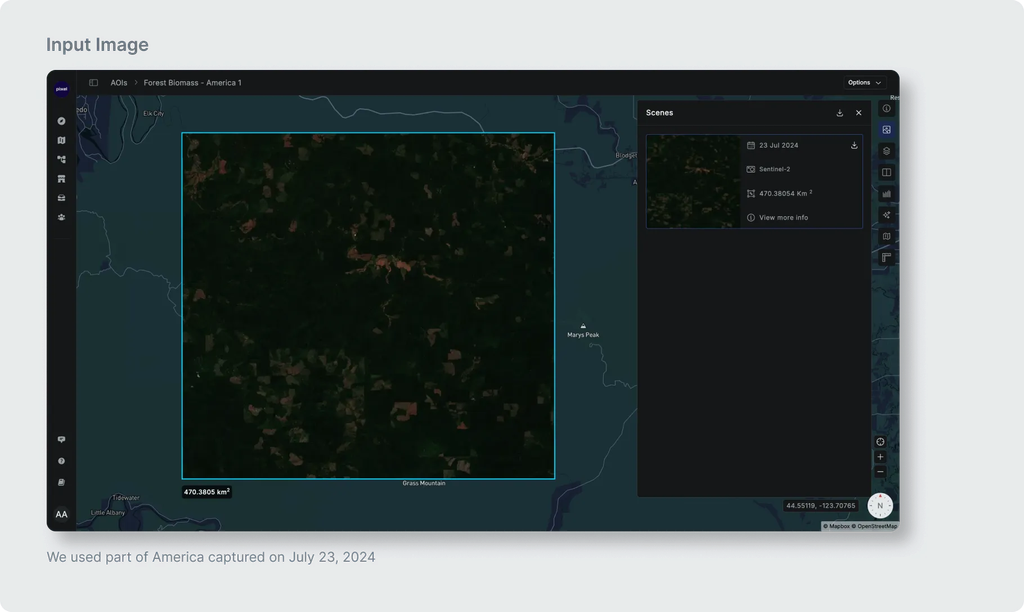
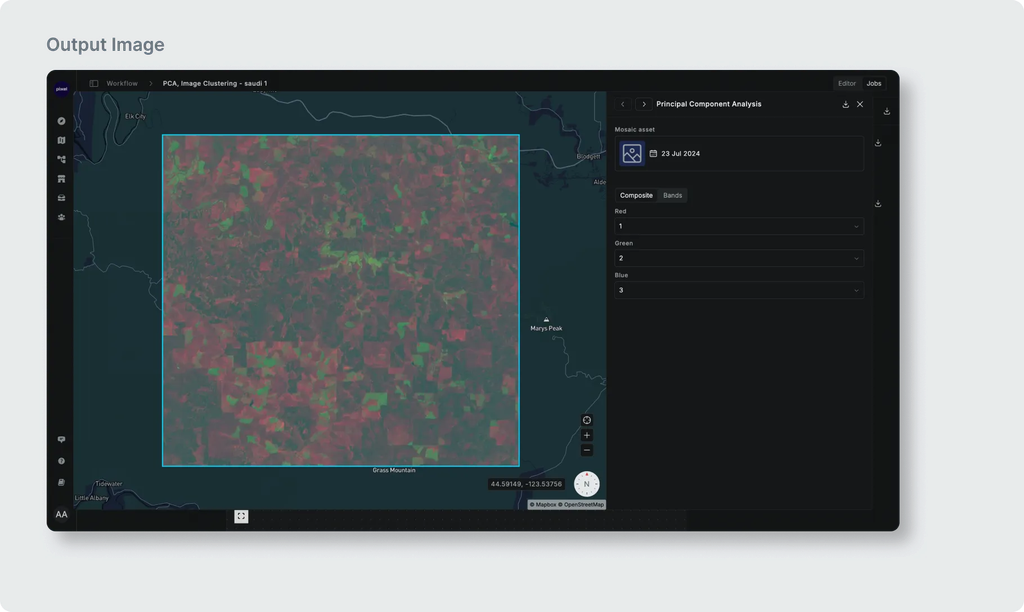
Principal Component Analysis (PCA) is a technique used in data analysis to simplify complex datasets. It identifies the most important patterns, reducing the data's dimensionality while preserving its key features. This helps in visualization and understanding of the data, making it easier to work with.

The model supports any imagery of arbitrary size. PCA in raster analysis has limitations. It assumes linear relationships, potentially missing complex non-linear patterns. It's sensitive to outliers, which can distort results. Additionally, interpretability can be challenging due to transformed components. Finally, selecting the right number of components requires careful consideration, impacting the quality of dimensionality reduction
Optical FusionModel Quick Tour