
Model Overview
Sensors Supported: Sentinel-1 and Sentinel-2
The aim of this model is to estimate Forest Above-Ground Biomass (FAGB), expressed in units of Mg/Ha (Megagrams per Hectare), at 500 m spatial resolution for any forest region across the globe from 2017 to 2023. Therefore, a pixel of the product (raster output from this model) would represent the average Forest Above-ground Biomass present in the forest in the respective 0.25 sq km for the chosen year. The biomass estimates are exclusively derived from SAR back-scatter values by employing a semi-empirical model. The open source C band radar dataset available from Sentinel 1 is used as the input to the model.
Use Case Example
Input
The model requires two inputs from the user.
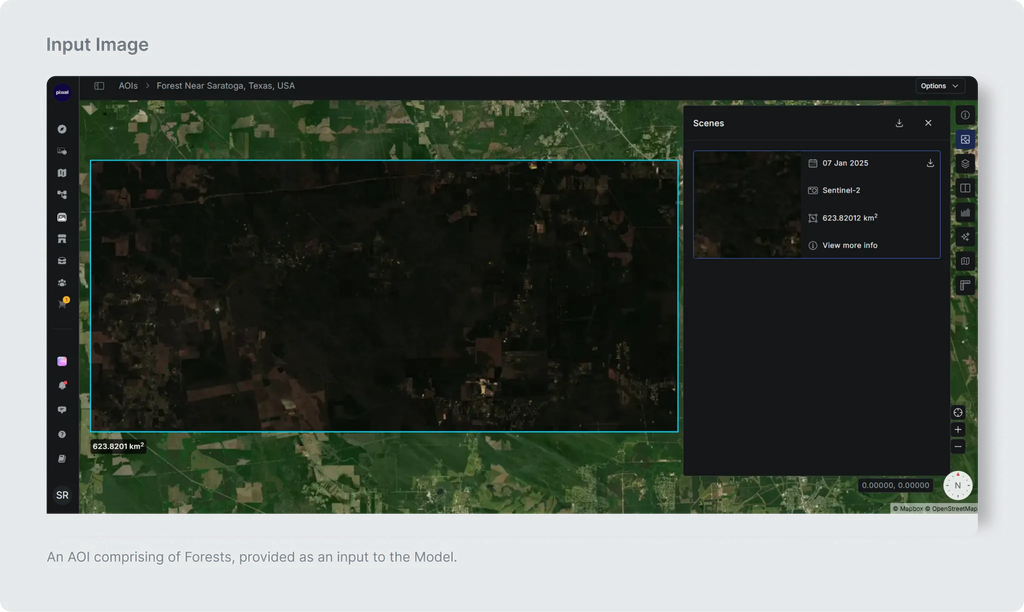
- An AOI (Area of Interest) predominantly constituted of forest (at least more than 5 sq km of the AOI is expected to be covered by forest).
- Year for which forest above-ground biomass (FAGB) needs to be estimated, which could be from 2017 to 2023.
All other variable layers required are taken care of by the model and hence, does not require any additional inputs from the user.
For below example 2023 is taken as input Year along with an AOI.
Output
As an output from this model, the user would be able to
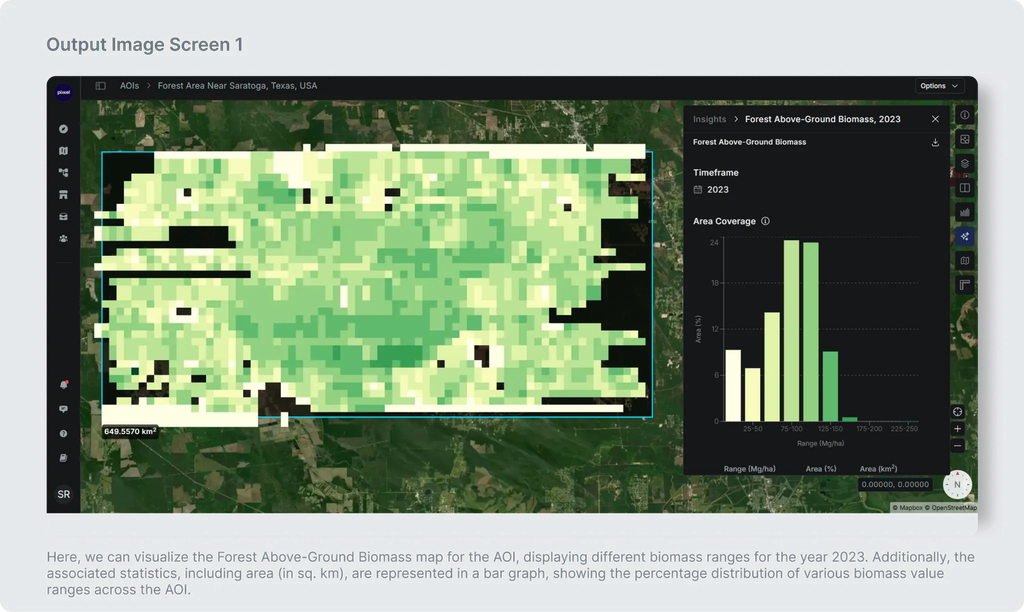
- Visualize the Forest Above-ground Biomass map on AOI at 500 m resolution, and
- View the associated statistics(Area in sq. km ) represented as a bar graph indicating the percentages for various ranges of biomass values across the AOI.
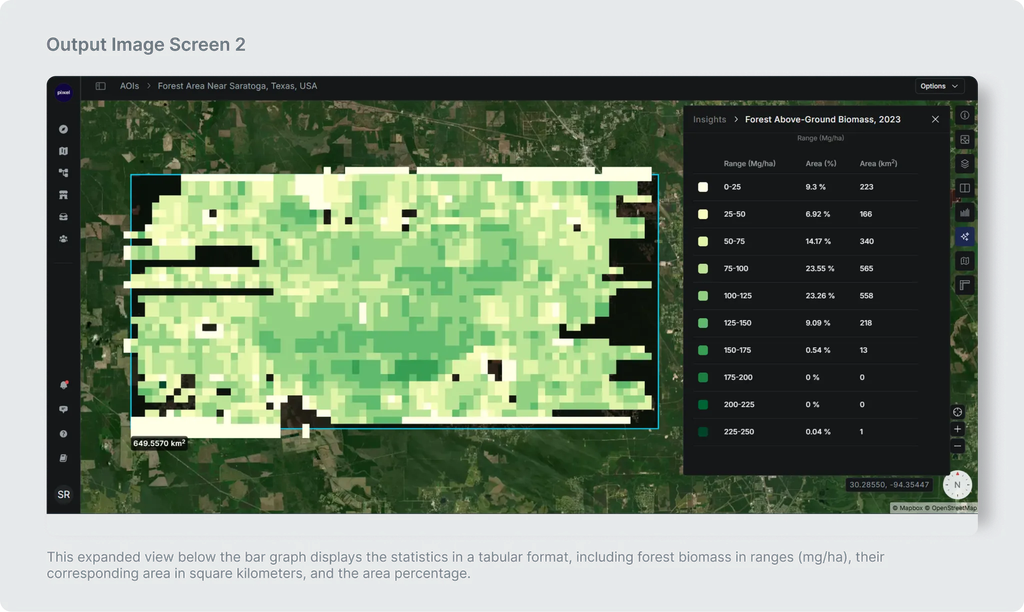
The User would be able to download the output containing a .tif file with Forest Above-Ground Biomass at 500 m resolution and a csv file with Forest Above-Ground Biomass statistics.
Additional details
Minimum size of Area of Interest supported (in Sq KMs.): 5 sq km
Maximum size of Area of Interest required (in Sq KMs.): 5000 sq km
Geographies supported : All the forest areas excluding very dense forest areas like the Amazon basin.
Sensors Supported: Sentinel-1 and Sentinel-2
Model Accuracy : The model is validated against Lidar derived FAGB datasets available for the given study area and further with GEDI derived FAGB values. The model tends to accurately estimate values below 120 Mg/Ha and saturates for values above. In the validation process, RMSE is in the range of 27 to 35 Mg/Ha and R is approximately 0.55m, while comparing for AOI’s in lower biomass values, i.e.,120 Mg/Ha, irrespective of the type of forest.
Important Note: Therefore, there is a probability that the accuracy metrics can be severely varied with the biomass range and year of estimation. The model relatively performs well for study areas for which forests are less dense, accounting for the penetration capability of the C band radar. Therefore, the model does not provide satisfactory results for values more than 120 Mg/Ha.